The short version Tonight: two sheets, ten minutes each, circle one sentence, and put it where your hand goes first when you open.
No ten quiet minutes, because the shop opens at five? Write one line on the back of an invoice: who you opened the doors for. Circle it. That is enough for this week.
You are good at the thing, and you hate the life around the thing. The bread, the wire, the books, the clean. The thing still works. The days do not.
You cannot remember the last day that was not a shift. A Monday the shop is closed is not a day off if you spend it on the letter, the tax folder, the thing you will not let anyone else touch. Closed is a sign in the window. You are still inside.
You are sharp with the person who loves you, about a small mess, and the apology is "it has been a lot at work," which has been true for so long it no longer explains anything. It is the weather report.
You look at a number and feel nothing, or you feel only the fear of the number, and you cannot find the sentence that used to make the number worth it. The sentence got replaced by the number. The facilitator in the book knows that swap. He ran a frame shop. By the later years he would have told you his numbers. He could not have told you why he opened.
You fantasize about a sale, or a manager, or a week where the phone does not know your name. The fantasy is not a plan. It is the old reflex begging for an exit that does not require you to feel the original reason, because the reason might hurt.
You stay because people depend on you, and the depending has become the reason, which means you no longer have one of your own. If you stopped, you are afraid the place would stop, so you are not allowed to ask why you started. The question feels like a luxury. It is the only question that makes the rest of the hours mean anything.
It usually starts as a busy season: a thing kept open, and the reason lost under the keeping. Seasons end. This one does not, until somebody writes the sentence down and puts it where the key is.
This page will not tell you to sell, to keep, or to hire.
What happened to the reason you opened?
Ken is 63. "Twenty-two years. Since I bought the place." He bought the bakery from Ada, and he is there at 3:30 because that is when the key has always turned. Nobody else has it, because nobody else has earned it, which is the story the old reflex likes. A renewal sits on the desk in a lawyer's voice: $4,600 a month, up from $2,800. He answers in that voice, the word heretofore included, because a fight he knows how to have is easier than a wish he does not. He mails the fight. The letter is wrong in a way he cannot name yet. It is his voice with a necktie on. It does not ask for anything he wants.
The room gives them two sheets and an envelope. Not mailed. Not a business plan. The facilitator framed other people's plans for a living. He does not want another one.
The first letter is to whoever you have been trying to prove something to. Ten minutes. Ken writes his like a bake sheet, numbers down the side, years and ovens and a morning a mill let people go and he walked down the street and asked for full-time. No name at the top. In a long life he never worked out who the case was for.
The second letter is to the one person you opened the doors for. Not customers in general. One person. Someone you wanted to make a thing for, or come home to, or build a room for when there was not one. Small words. They already like you. Ken tries not to write to Ada, who has been dead for years, whose letter to him is in the safe. He writes to the bakery instead, which feels safer, and then a sentence arrives that he did not schedule. He wants it to still be Linden's after him.
Sergio circles a line to his daughter: he wants to come home while it is still light.
Paige circles a fact, not a feeling: a rate she had not moved. The room lets it be a fact.
Read both letters to yourself. Circle the truest sentence. Tape it where you look first when you open up. Leave it on the bench. Don't frame it yet. Framing turns a sentence into a plaque, and then you go back to the numbers.
If this is keeping you from sleeping or eating, or it is not easing, talk to your doctor or a counselor. If it has gone darker than that, or you are having thoughts of not wanting to be here, call or text 988 in the US, any hour.
Why does the lawyer letter miss the point?
Ken mails the lawyer-voice letter anyway, the first time. The sentence he circled is not in it. That is the gap. You can win a fight with a landlord and still be speaking in a necktie, and the necktie does not know why you bought the place. The sentence on the bench is the correction. Not a strategy. A correction of voice.
Later he brings Ada's starter and the letter he could not read aloud. She told him to teach it to someone. The starter is a jar he carries with both hands. The teaching is the opposite of being the only one with the 3:30 key. The page you write is not that ending. It is the sentence that makes an ending imaginable. Without it, someone else locking up sounds like a threat. With it, the lockup is how the thing continues.
The bench is deliberately unimpressive. A scrap. Not a brand statement. Not a values poster the crew will ignore. For two weeks the scrap has to be ugly enough to be used. You look at it when you open. You do not polish it into a slogan. If you start editing the sentence into something more impressive, you are back in the necktie. The impressive version is for an audience. The circled version was for the person you opened the doors for, and that person does not need your best prose.
If the only sentence you can circle is a complaint about the landlord, the season, or the help, leave it and ask again. Complaints can be true and still be the weather. A fight with no sentence under it is how an owner spends years and then cannot say why the tiredness came. The sentence was never put where the hands could see it.
Where does the sentence live, if not in the renewal?
Circle 3 is what you cannot control: the rent, the season, the customer who will not pay, the landlord's lawyer, the fact that a body gets tired. The figures on Ken's desk are the weather. You do not circle them and call them your why. Naming them keeps them from impersonating your purpose.
Circle 2 is where you have influence: the person you might teach, the way Ada told Ken to teach someone. The head baker, a closer, a kid who wants the counter. They may not want it. The offer is not the same as handing them your worth to carry. The sentence stays yours even if they say no.
Circle 1 is the two letters, the circle, the scrap on the bench, and the decision not to frame it or mail it to a landlord. Worth lives in Circle 1. Nowhere else. The worth is in that scrap. Not in a sale, and not in a martyrdom that calls itself the only way the doors stay open.
What do you write across the two weeks, without a verdict?
- Write the two letters. Ten minutes each, or as long as the first sheet takes. Who you have been proving something to. Who you opened the doors for. Do not mail them. Do not show them if showing would turn the letter into a negotiation. Circle one sentence. If you hate it, it is probably the one. Ken hated the words "after me" and they were the point.
- Put the sentence where your hand goes first. The bench, the visor, the inside of the register. For two weeks you look at it when you open, and you do not turn it into a plan.
- No sale, no second shop, no speech, for the length of those two weeks. The fantasy can be written on the back of the sheet if it will not leave you alone, and then it stays on the back. The front is the sentence. If you need other owners for this, that loneliness has its own page: The loneliness of owning the place. If the thing you cannot put down is a rate, that fear has its own page: Afraid to raise your prices.
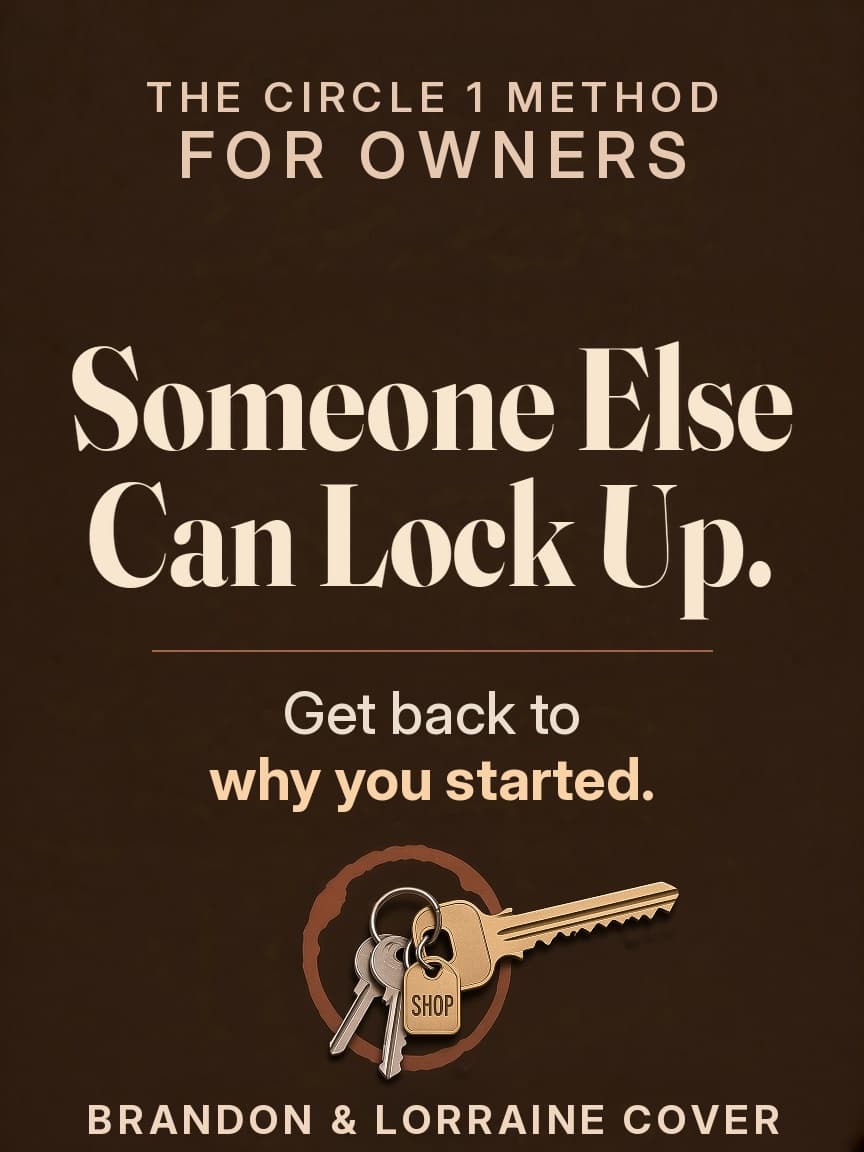
The book is the fourteen Mondays around that scrap, starting with the two weeks it sits on the bench, unframed.
Find your pattern · free 3-minute quiz →
Download this guide (PDF)