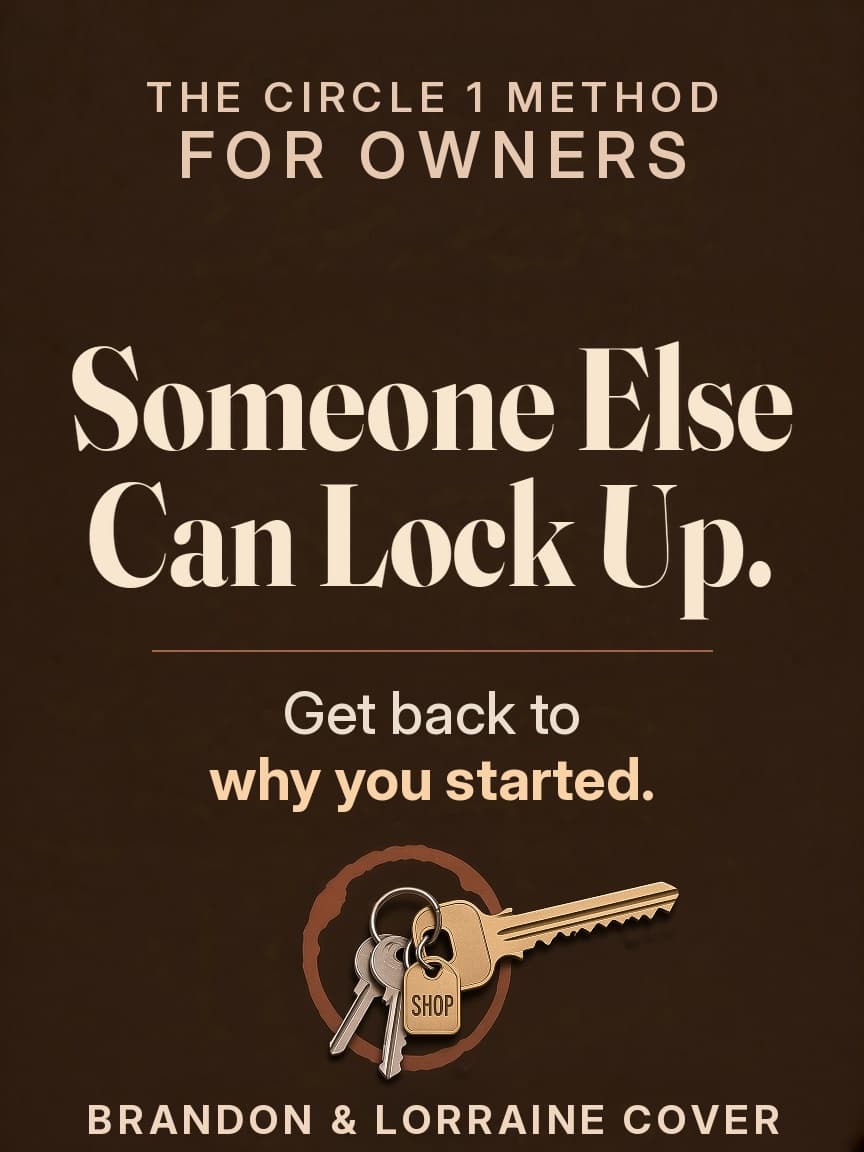
The short version Tonight, write down every key you carry, and next to each one, who else could hold it.
If nobody else can hold any of them yet, the list is still the move. Pick the one key where a name is closest and write the name in pencil.
You open the front, the back, the register, the closet nobody has needed since the last owner. It is early. You are the only one who knows the order, so the order has become you.
You gave someone a spare once. That night you drove past to see if the lock had worked. From the street. With your eyes. They had locked it. You still slept lightly.
You say it is faster if you do it yourself, about a job that takes half an hour. You are right about the half hour in front of you. You are not counting the year.
You go on vacation in the way owners go on vacation, which is to say the phone comes, and the phone is the business, and the people who love you get the part of you that is left after the phone. You call that dedication. They call it something shorter, and they have stopped arguing.
A job is finished. You have the photo. You go back anyway, after dinner, after a child's game, because finished is a word other people use. You use "let me check," and the check finds nothing, and you drive home with the same key you arrived with.
The sign says closed. You are inside. The one thing only you can do has turned into everything, because you never wrote down the difference.
It usually starts with a drive you call standards, back to a thing that was already right. The standards were real. The trip was the old reflex, looking for proof that the place still needed your hands. The handoff is how the proof stops getting a vote. The recheck itself has its own page.
Why are you the only one who can open it?
Sergio is 39. He runs an electrical crew of four. His tell is the tape measure on his belt, the click when his thumb works the blade and lets it snap back. At 10:15 on a Sunday he lets himself into a dentist's office that is not open and is not his. The key is still on his ring because nobody asked for it back. The job is done. On Friday his foreman, Wes, landed the last circuits, labeled the panel, swept, and sent a photo. Sergio answered the photo with a thumbs-up. Then he thought about the panel through a soccer game and a birthday dinner, and now he is here.
He shuts the main off, because he is tired and not stupid. The torque screwdriver is set to the number on the breaker. The first terminal clicks without moving. Wes set it right. That side of the panel is 11 terminals. None of them gives him a quarter turn of anything to fix. He drove 20 minutes at night to learn what Friday's photo already said.
His wife, Elena, texts. Are you close? Almost done, he answers, which is true in the narrow way. On the visor is a drawing their daughter Lucía made. The van, a ladder the size of a telephone pole, a stick figure alone in a yellow hat. DADDY WORK across the top, the last letter crowded onto the back because she ran out of room. The figure is alone in the picture. He is alone in the office. The rhyme is not subtle, which is why he does not look at it for long.
On Monday the facilitator asks five owners to put their key rings on the library table. More keys than the room has doors. Sergio's eleventh opens a job that is not his anymore. It is the inspector's, and it is Wes's, and the three paragraphs of code he used to write into every estimate were that key on paper. The question the facilitator asks is not a management slogan. Whose is it? Is this mine?
Wes says the rest later, and it lives on the next page. Here the point is smaller: the key was still on Sergio's ring because nobody ever wrote down when it stopped being his.
What goes on the one page?
The book does not hand Sergio a software stack and a vision. In the chapter called Spare Keys he hands Wes the keys to a job with one page. What done looks like. When to call him. When he is not coming.
That is the whole handoff. Three lines a foreman, a closer, a baker, or a cleaner can use without calling you:
- What done looks like.
- When to call me.
- When I am not coming.
What done looks like. Not "use your judgment," which is how owners stay in the truck. A sentence someone else can check without you. Wes could already do this. The page makes the check his, in the open, instead of Sergio's, in the dark, after a birthday dinner. If you cannot write what done looks like, you do not have a standard. You have a mood. Moods do not hand off.
When to call me. The real list, short. Safety. A customer who is about to leave angry in a way that will land on the company. Money above a line you name. Not "if you are unsure," which means always, which means the key never left your ring. If it is not on the list, they do not call, and you do not punish them later for not calling. Punishment after the fact is how the handoff dies.
When I am not coming. The sentence owners skip because it feels like neglect. It is the opposite. It tells the other person the job is theirs past a point, and it tells your old reflex it does not get a vote at 10:15. Sergio's later night is a drive past a job the crew finished. He slows down. He does not stop. That key is not his.
Code and safety are the floor. Wes makes a real mistake at a rough-in and fixes it. The handoff is not permission to be careless, and it is not permission to re-enter every job because a mistake is possible. A mistake that gets fixed inside the floor is the work. Your presence at every torque check is the pattern. How to stop the recheck, once the page exists, is the next page.
This page will not tell you how to write a contract, what insurance requires, or how to classify anyone who works with you. Those belong to your trade and your counsel. The page is the three lines. If a job is unsafe, you go. The floor is the floor.
Which key is yours, and which is the weather?
Circle 3 is what you cannot control: the customer who will not pay, the inspector's calendar, the landlord, the fact that a good person may leave for a job you cannot match. Sergio's best journeyman, in the book, gives notice for work a four-person shop cannot offer. That leaving is outside your control. You cannot hand off your way out of a market. You can stop using the market as the excuse to keep every ring.
Circle 2 is where you have influence: the person you are handing to. Wes, or whoever has earned the page. They will do it differently. Different is not wrong unless it misses the done line or the floor. If you only trust a clone of your hands, you do not have a business. You have a job with overhead.
Circle 1 is the page, the key you take off the ring, and the drive-by you do not stop for. Worth lives in Circle 1. Nowhere else. A person who holds every key cannot remember why they started. The keys are too loud. One key off the ring is how the reason gets a word in.
What does a Tuesday look like with one key off the ring?
Pick the job that already has a person, and walk the day as if the page were real.
Morning: you write the three lines before the truck moves, not in the driveway after you have already decided to go look. What done looks like, in words Wes could check with his own eyes. When to call, a list short enough to fit on the back of the page. When you are not coming, including the hour after dinner, which is the hour the old reflex prefers. You hand the page over with the key or the code. You say it once. You do not add a speech about how hard it is for you. The speech puts the key back in your pocket while the metal is in theirs.
Midday: the urge arrives, usually dressed as a small errand. You are "in the area." The area is a choice. You do not go. If the phone rings and the reason is on the list, you answer and you stay on the list. If the reason is not on the list, you ask them to decide it, and you do not punish a decision that meets the done line even if you would have done the last inch differently. The last inch is where the way you cope lives, the one that will not count the job until your hands have been on it. It is also where crews learn that the page was theater.
Evening: you do not drive past. Sergio's drawing on the visor is a man alone. The practice is to not add another night to that drawing. Eat where you said you would eat. If you fail and you go, write it down as a trip, not as a virtue. A trip you will not count is a trip you will repeat. One key, one day, one skipped drive. Owners try to hand off the whole life on a Monday and take it all back by Wednesday. One key is how Wednesday does not win.
What do you write down before the next drive?
- Name every key. On the table, or on a napkin in the truck. What it opens. Who else could hold it. Sergio's eleventh opened a finished job. Yours has a cousin: the security code, the password only you know, the vendor who will only talk to you because you never introduced anyone else. A key you will not name is the one the old reflex is keeping.
- One job, one page, this week. Not the whole company. One job that already has a person. What done looks like. When to call. When you are not coming. Hand it over with the key, or with the password, or with the shift. Then leave. If you hover, you taught them that the page was a suggestion. Ken sets the 3:30 bakery key down in front of his head baker. The picture is the key on the table, not a speech about trust.
- One drive-by you skip. The finished job, the closed sign, the camera you were going to check from the couch. Skip one. Write down what you were afraid you would find. If the answer is proof it was done right, that fear has a name on Why you can't delegate.
The text at 9:40 is Clients texting after hours. The rate letter in drafts is Afraid to raise your prices. The review that takes the night is One bad review.
The Sunday night with the 11 terminals is on the owners page. The book is the fourteen Mondays between that panel and the night he drives past a finished job without stopping.
Find your pattern · free 3-minute quiz →
Download this guide (PDF)