
For teachers · Book coming soon
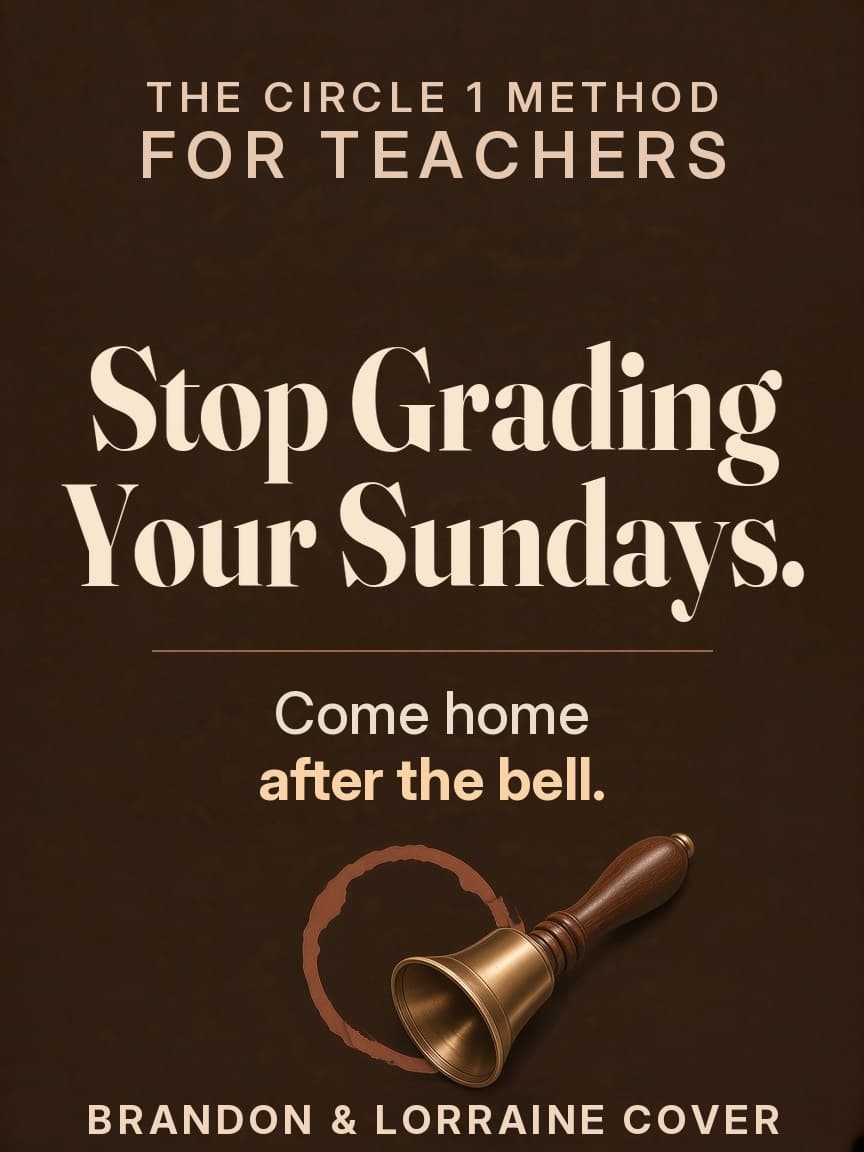
Stop Grading Your Sundays.
Come home after the bell.
Tote bag buckled into the passenger seat again? Tonight, empty it onto the table and make two piles: what has a real due date, and what goes back to school.
Get the free guide: 7 reasons the work comes homeOr find your pattern · free 3-minute quiz → Email me once, when the book is out →
Is this you?
Signs the bell didn’t end your day
- Your contract day ends at 3:30. You have never seen your classroom at 3:31 from the outside.
- Your tote bag rides in the passenger seat, buckled. You check on it at red lights the way other people check on kids.
- You told your family you’d grade “a few” tonight. The stack is taller than the takeout menu you corrected while you were at it.
- You have written a comment longer than the paragraph it was about. The student read the grade, said “cool,” and made a paper airplane.
If you bought the good pens and told yourself they would help, you are in the right place.
Seven of these have a longer page, and a free PDF. Why the work comes home after the bell
From the prologue
Read the opening
On Tuesday afternoon Shannon Pierce sat in her car in the faculty lot with 88 essays beside her.
The tote was canvas, and it was buckled in. She started doing that the year one slid off the seat at a stop sign and scattered a whole class of sophomores under the brake pedal. She was not embarrassed by the seat belt. She was a little embarrassed that the tote sat up straighter than most of her sophomores.
She took the top one out and uncapped her red pen. The essay was decent. The boy put a real idea in his second paragraph and then buried it under a quotation the length of a grocery receipt. By the bottom of the first page the essay held more of her handwriting than his typing.
She counted, as she did lately. Page one carried eleven comments. Her usual was about thirty an essay. She came to that number nine years ago, after an administrator sat in the back of her class with a laptop for forty minutes and sent back a form. One sentence near the bottom of the observation called her feedback adequate. Nothing was circled.
At 4:40 the lot was nearly empty. She capped the pen. With 74 essays to go, at this rate she needed thirty-seven more hours. She did the arithmetic in her head, though she was the English teacher.
A yellow flyer marked her place in the stack. A Circle 1 workshop for teachers. Wednesday afternoons, 4:45 to 6:45, the library community room. Sixteen Wednesdays. You’re tired, come anyway.
Excerpt from the prologue of Stop Grading Your Sundays. © 2026 True Path Publishing.
The tote is still buckled in.
Get the free guide: 7 reasons the work comes homeWhat this book does for you
The bell rings. The buses leave. The tote stays buckled in the passenger seat. For 16 Wednesday afternoons, five teachers answer one question. What are you carrying past the bell? That is Circle 1 for Teachers.
Shannon’s essay ends up with more of her handwriting than the student’s typing. Her usual is about 30 comments, counted since the year one sentence near the bottom of an observation called her feedback adequate. Penny is carrying a boy in the same sweatshirt, six days running. Raquel checks the minutes each child was owed against the minutes each child got.
Class size, the schedule, and what a student does with a comment go in the outer ring. The center is the comment you choose, the hour you keep, and the reason you took the job.
Worth lives in Circle 1. Nowhere else.
The good pens were never the problem.
Seven reasons the work comes home
One of these is the one that kept the tote in the car.
Seven ways the work follows you past the bell, with a small mechanical move for each. Start with the title you did not want to click.
Teacher Sunday scaries
Saturday holds. Sunday night, the week sits down beside you, and the tote is already buckled in for a Monday that has not started.
Read the guide → 02 Free guide · PDF includedHow to stop taking work home
The contract day ends. The tote does not. The hours after the bell are not all the same kind of work, and the bag cannot tell them apart.
Read the guide → 03 Free guide · PDF includedWhy grading takes so long
The paper ends up with more of your handwriting than the student’s typing. The pen is answering an old form, not the student in front of you.
Read the guide → 04 Free guide · PDF includedTeacher guilt
The sick day, the extra duty, the twelfth coat. The bill was the building’s, and the receipt said love.
Read the guide → 05 Free guide · PDF includedShould I quit teaching?
The letter can sit on the table all evening without your name at the bottom. The building is one column. You are the other.
Read the guide → 06 Free guide · PDF includedThe angry parent email
You have a draft with attachments and a subject line that has already been revised twice. The send button is a courtroom. Three lines will hold what the folder cannot.
Read the guide → 07 Free guide · PDF includedI feel like a bad teacher
One sentence near the bottom of an observation. Years later the pen is still answering it. The form had one line of data. The rest got a vote it did not earn.
Read the guide →What is in the book
Five teachers. Sixteen Wednesday afternoons. One library table.
Each chapter ends with one small move you can try on your next school night. Seven of them are free right now.
Who wrote this

We noticed that books meant to help teachers tended to be the books teachers never finished. Too dry. Too clinical. Too much like homework after a day that ended with a tote you were still grading on the kitchen counter.
So we wrote the one we wanted to read: something fun, specific, and built around a story you actually follow, with the patterns inside it that work on the Sundays that start at four and the Wednesdays that start at six.
Lorraine brings the heart and the creative instinct. Brandon brings the process and the Method.
We did not write this from a hilltop.
Brandon and Lorraine Cover, True Path Publishing
Send it to a friend
The person still grading at the kitchen table. Send them this page.
Be first to know
We’ll email you once, when this book is out.