
For nurses · Book coming soon
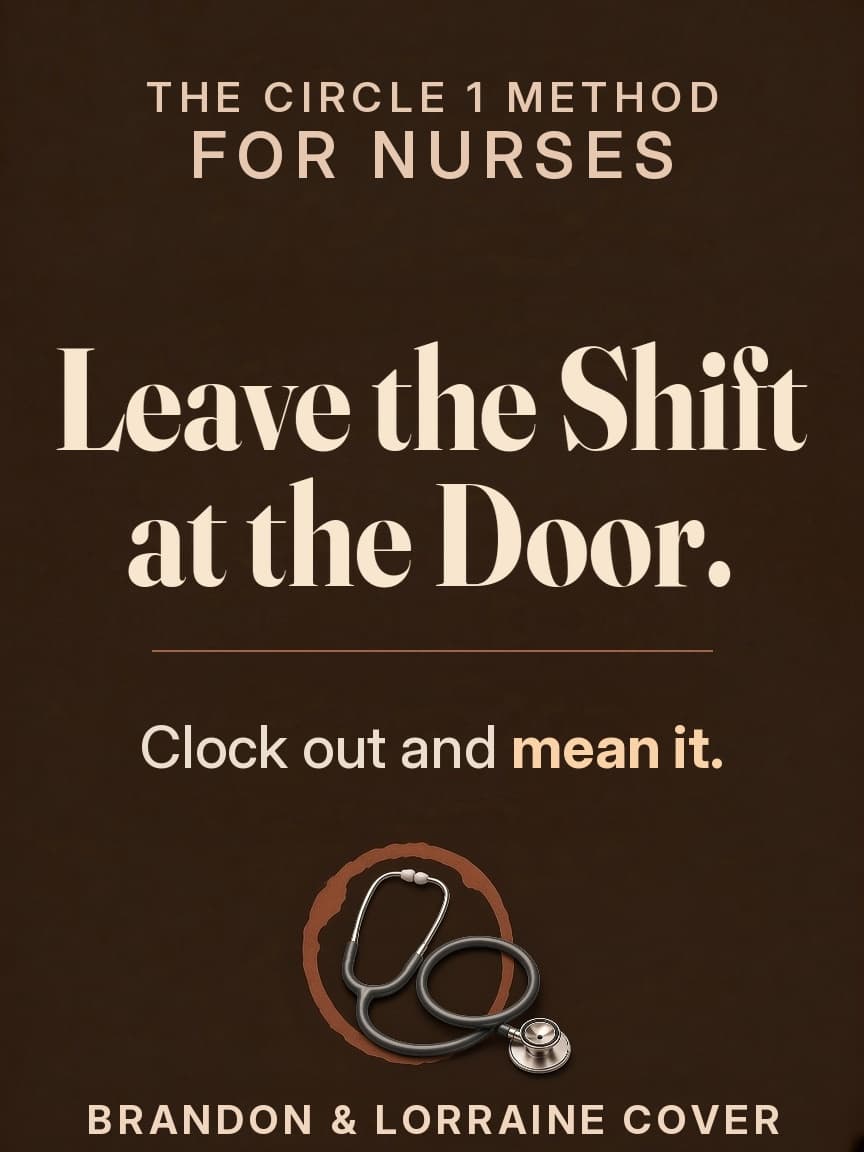
Leave the Shift at the Door.
Clock out and mean it.
Still charting in the parking garage after you clocked out? Start tonight with one question: is this mine, and who is it for?
Get the free guide: 7 reasons the shift follows you homeOr find your pattern · free 3-minute quiz → Email me once, when the book is out →
Is this you?
Signs the shift came home with you
- You clocked out at 7:38. It is 8:14, and you are still in the parking garage in your scrubs, charting with your thumbs.
- You have driven back to the unit from the highway to make sure you signed something. You had signed it. You signed it again in your head on the way home.
- Your family asks how your day was, and you give them an organized report, by system, and then ask if they have any questions.
- You woke at 3 a.m. certain you never told nights about the potassium. You told nights about the potassium. You told them twice, and one of them wrote it on her hand.
If you’ve ever sat in that garage, on Level 2, the one with the bad light, this is for you.
Seven of these have a longer page, and a free PDF. Why the shift follows you home
From the prologue
Read the opening
Stephanie had clocked out at 7:38 on Monday night. She remembered doing it, because the time clock had beeped at her badge twice before it took.
At 8:14 she was still in the hospital garage, on Level 2, with the engine off. Nobody was paying her for this part of the day. She had her phone propped against the steering wheel and the hospital’s charting app open, and she was adding a late entry to a chart that was already complete.
The day was documented, and she knew it.
The note she was writing now said it again. She typed RN remained at bedside throughout and studied the word throughout. Then she added the time she had stepped out to get the daughter a chair, and the time she had stepped back in. It was forty seconds.
Without noticing, she had put two fingers of her right hand on the inside of her left wrist. She was counting her own pulse against the second hand of her watch.
Her phone buzzed over the top of the note. It was Glen. Chicken’s in the oven. No rush. Well, a little rush.
She did not answer yet. She read the late entry from the top, the way she would read it if she were someone else, a person in a blazer at a long table with the chart printed out and a highlighter. That person had never existed. No one had ever called Stephanie into a room about bed 9, or about any bed, in fifteen years. But she wrote for that person every night, and that person was never satisfied.
She saved the note. Her pulse was ninety-four.
On the way out of the unit she had passed the break room corkboard, where a new flyer was pinned over the old potluck sign-up. She had read it while she waited for the elevator. For nurses. Tuesday nights, 6:30 to 8:30, the library community room. Fifteen weeks. You’ll get a real break at 7:25. Somebody had drawn an arrow to the last line and written lol in pen. She had taken a picture of it. She did not know why. She started the car at 8:21 and went home to the chicken.
Excerpt from the prologue of Leave the Shift at the Door. © 2026 True Path Publishing.
The shift got in the car.
Get the free guide: 7 reasons the shift follows you homeWhat this book does for you
You clock out, and the shift gets in the car anyway. For 15 Tuesday nights, five nurses sit at a library table and sort a shift into three circles. That is Circle 1 for Nurses.
The outer circle is the building. Staffing. The census. 14 boarders in a hallway, one of them there since Saturday. Nobody in the room caused that, and nobody in the room can breathe their way out of it.
The center is smaller. Your hands. Your breath. What you say, what you write, and who the note is for.
Worth lives in Circle 1. Nowhere else.
If you have sat in that garage after the badge already beeped, start here.
Seven reasons the shift follows you home
One of these is the one that tightened your jaw.
Seven ways the shift comes home with you, with a mechanical next move for each one. Start with the title you did not want to click.
Post-shift anxiety
The chart is already done, and you are still in the garage, writing it again for a person who was never going to call.
Read the guide → 02 Free guide · PDF includedHow to decompress after a 12-hour shift
The advice says rest. The body says the shift is still on. Ten minutes in the car, before the badge, is the practice that fits.
Read the guide → 03 Free guide · PDF includedSaying no to extra shifts
The text comes at 4:02. The yes is already in your thumbs. The short shift is the building’s, and the sentence is yours.
Read the guide → 04 Free guide · PDF includedMade a mistake at work
You caught it. You reported it. The old reflex kept the file anyway, and it has been the night shift in your head ever since.
Read the guide → 05 Free guide · PDF includedDreading your next shift
You are awake at 3 a.m. with a shift that has not started, and your body is already on the unit. The thought shows up later, to explain the heart rate.
Read the guide → 06 Free guide · PDF includedBurned out on bedside nursing
The word you reach for is burned out. Under it is a mix: the building’s math, and the part that is still yours. Sort them before you decide.
Read the guide → 07 Free guide · PDF includedThe patient you still carry
The chart is closed. The patient is not gone from the car. The last report was never yours to file, and it is still yours to finish.
Read the guide →What is in the book
Five nurses. Fifteen Tuesday nights. One library table.
Each chapter ends with one small move you can try on your next shift. Seven of them are free right now.
Who wrote this

We noticed that books meant to help caregivers tended to be the books caregivers never finished. Too dry. Too clinical. Too much like homework after a shift that ended with a chart you were still writing in the car.
So we wrote the one we wanted to read: something fun, specific, and built around a story you actually follow, with the patterns inside it that work whether the shift ends at 7:30 or seven hours after.
Lorraine brings the heart and the creative instinct. Brandon brings the process and the Method.
We did not write this from a hilltop.
Brandon and Lorraine Cover, True Path Publishing
Send it to a friend
The person still charting in the car. Send them this page.
Be first to know
We’ll email you once, when this book is out.