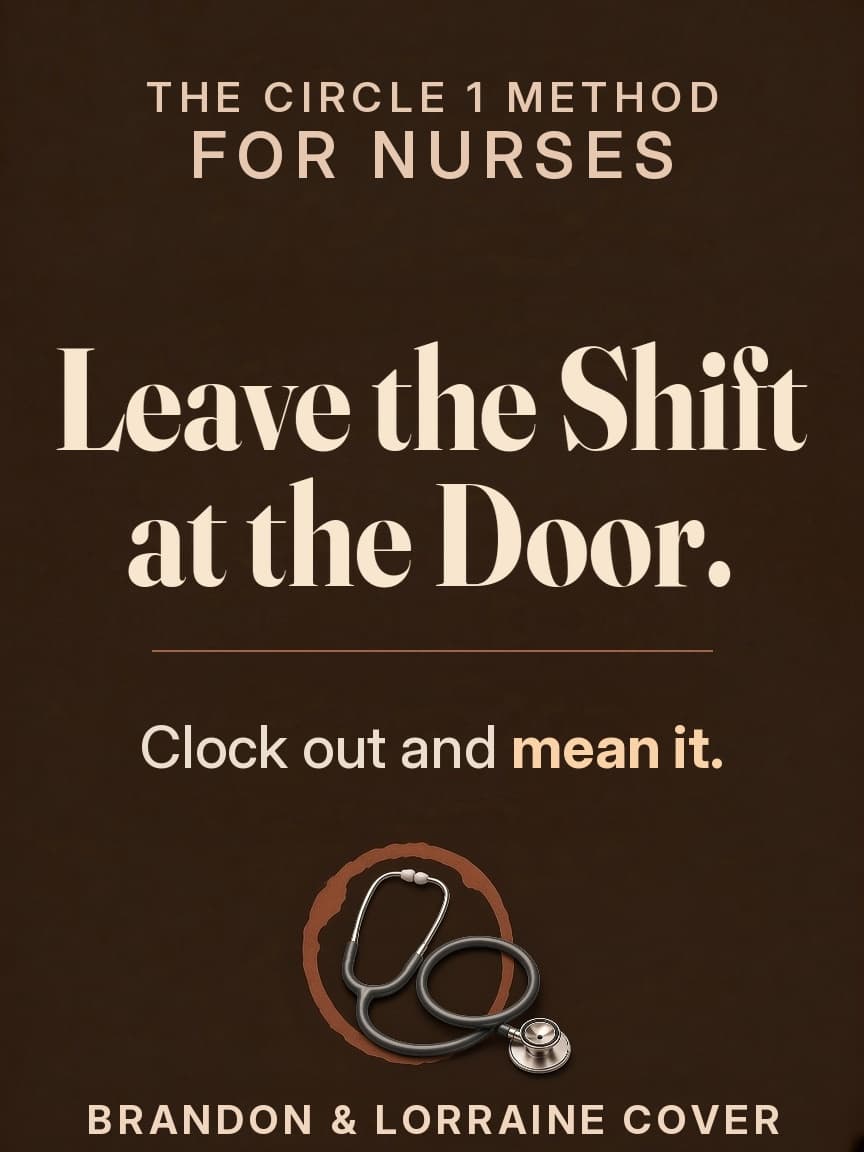
The short version Tonight, before you add one more line to a chart that is already done, ask: is this mine, and who is it for?
If you are already at home with the app open, the question still works. One sentence, then close it.
You clocked out. The badge beeped. You are in the garage with the engine off, and the charting app is propped on the wheel, and you are adding a late entry to a note that was already complete.
You have driven back from the highway to make sure you signed something. You had signed it. You signed it again in your head on the way home, and then you signed it a third time in the parking lot, because the second signing did not stick.
Your family asks how the day was. You give them an organized report, by system, and then you ask if they have any questions. They wanted to know if you were hungry. You handed them a handoff.
You woke in the night certain you never told the next shift about the potassium. You told them. You told them twice, and one of them wrote it on her hand. The hand is not in the room with you. The doubt is.
You put two fingers on the inside of your wrist without deciding to. You are counting your own pulse against the second hand, in a car that is not a unit, on time nobody is paying you for.
You read the note the way a stranger in a blazer would read it, at a long table, with the chart printed and a highlighter uncapped. That person has never called you in. You write for them every night, and they are never satisfied.
If your stomach just clenched, you are in the right room.
If you have stayed with a page that was already finished, because finished did not feel safe, this is for you. The page was not the problem. The old reflex working on the page was. Stephanie, the ICU nurse in Leave the Shift at the Door, knows it too. She clocks out at 7:38 and is still on Level 2 of the garage at 8:14, adding a late entry nobody asked for.
Why does the late entry feel like diligence?
Stephanie remembers the beep. The time clock took her badge on the second try. Nobody is paying her for the part of the day that happens after that. She has the hospital's charting app open, and she is writing the day again.
The day was documented, and she knew it.
The new note says it again. She types RN remained at bedside throughout and studies the word throughout. Then she adds the time she stepped out to get a daughter a chair, and the time she stepped back in. It was 40 seconds. She puts the 40 seconds in the chart because a person she has invented might decide that 40 seconds was the hole.
Her phone buzzes over the note. Glen, at home. Chicken's in the oven. No rush. Well, a little rush. She does not answer yet. She reads the late entry from the top, the way she would read it if she were someone else. She saves the note. Her pulse is 94. She starts the car at 8:21.
She has worked 18 years. In 15 of them, nobody has called her into a room about a bed. She writes for that room anyway. The person in the blazer has never existed. The note is for him.
That is post-shift anxiety when it is wearing its most flattering coat. It does not feel like fear. It feels like being the nurse who does not leave holes. The honest names you have given it are not entirely wrong. I am thorough. If I do not write it, nobody will know I was there. The family deserves a complete record. Some of that is true. The required note is true. The second note, the one that exists so an imagined inquiry cannot catch you, is the old reflex.
Which way of coping keeps rewriting a finished chart?
The way of coping her old reflex reaches for is Standard-Setter, the one that stalls by raising the bar. The standard is real. The standard is also the wall. You do not look stuck. You look careful. You look like the nurse who stays.
The way you cope does not kick in when the work is still in front of you and the patient needs a thing. It kicks in at the door of done. Done means someone else could read it. Done means you could be judged. The extra paragraph is a lock on that door.
The other ways of coping have their own pages. On Stephanie, this one is the stalling that looks like craft. The chart is the craft. The second writing of the chart is the wall.
The diagnostic is the timing. If you are still charting a finished day in a parked car, you are not documenting. You are buying a few more minutes in which nobody can say you left a gap.
Why does the usual advice fail when the old reflex is running?
The advice you have already been given is not foolish. It is aimed at a different problem.
Leave it at work. You would, if the part of you that is still on the unit believed the note was finished. The advice treats the replay as a choice you are making with a calm mind. The replay is what the reflex does instead of letting you drive. You cannot talk a surge out of a garage. You can catch it, and you can ask one question before you type the next sentence.
You care, and that is why it follows you. Caring is not the mechanism. Stephanie cares, and the chicken is getting cold, and the caring has been recruited. The reflex uses the part of you that is good at the job. That is why the extra note feels like love of the work. It is the reflex borrowing your competence.
Try not to think about it. An instruction to stop a replay is a second job, done badly, in the same car. The mind does not empty because you told it to. It empties when the note has an owner and a finish line. Until then, "don't think about it" is a request to hold your breath.
All three fail in the same place. They assume the problem is the content of the day. When the old reflex is running, the problem is who the note is for.
Why do the required note and the defensive note feel like one task?
The required note and the defensive note are not the same object. One of them belongs in the chart. It is the record a patient and the next shift need. The other is a speech to a hearing that has not been scheduled. They sit in the same text box, which is why they feel like one task. They are not. The book draws that line in the first chapter, the one called Late Entry. The required note is outside your control in the sense that the job demands it, and it gets written. What you control is how you breathe while you write it, and the moment you decide it is done.
The blazer is a way of coping your old reflex hired. Stephanie has a specific reader who has never been in the building. He has a highlighter. He is disappointed. If you have a version of him, he probably has a title. Risk. Quality. A lawyer. A manager you had 8 years ago. Name him once, on paper, not in the chart. A named reader can be retired. An unnamed one rides along for the whole drive.
Going back to the unit feels like safety and trains the old reflex. The highway turnaround, the second signature, the text to a coworker asking if you mentioned the thing you mentioned. Each one buys a drop in the charge, and each one teaches the reflex that the drop is available if it keeps the file open. The charge comes back tomorrow a little cheaper to start. You are not weak for going back. You are rehearsing a ritual that cannot end, because the blazer is never satisfied.
What question sorts one sentence?
On the first Tuesday, the facilitator writes a sorting question on a whiteboard that does not roll straight.
Is this mine, and who is it for?
She had been a bedside nurse. Her line, said once, is that her back left before she did. She does not pretend the building is fine. She draws three circles, lopsided, and then she gives the nurses the second half of the question, because for this job "is this mine?" is not enough. A note can be yours to write and still be for the wrong person.
The card that goes behind the badge says the same thing. Signal and noise. The question: is this mine, and who is it for?
Here is how to use it on one sentence, not on your whole career.
Read the sentence you are about to add. Ask the question out loud if the car is empty, and silently if it is not.
Is this mine? The clinical fact, the handoff, the thing the next nurse needs: yes. The 40 seconds of a chair, written so a stranger cannot accuse you of leaving: that sentence is yours in the sense that your hands are typing it, and it is not yours in the sense that the job required it. The job required the true note. It did not require the defense.
Who is it for? If the answer is the patient, the family who asked a real question, or the nurse taking the next shift, write it clean and stop. If the answer is the blazer, the hearing, the version of you that gets fired in a daydream, do not write it. Cross the impulse out. Leave the line unwritten. Stephanie, later in the book, reads one of her after-shift notes aloud and hears the prosecuting voice in it. She sorts which lines protect a patient and which lines protect her. She crosses one line out and leaves it crossed out. That is the move. Not a better speech. A deleted sentence that stays deleted.
The question is not a mood. It is a sort. You can run it in the time it takes the app to load. You do not need the whole book to run it once.
Worth lives in Circle 1. Nowhere else.
Where does one late note sit in the three circles?
Circle 3 is what you do not control. The census. The staffing. The boarder who has been in the hallway since Saturday. What a review would say if a review ever happened. Whether the family believes you. You can write a perfect paragraph and still not control any of that. The building is the building. Naming it is not an excuse. It is the only way the rest of the sort stays honest. If everything is "your responsibility," the extra note looks mandatory. It is not.
Circle 2 is what you influence. The handoff you give. The tone of the one call back you promised a daughter. The way the next shift hears the one fact that matters. Influence is not control. You can do the handoff well and still not control what they do with it.
Circle 1 is what you control. Your hands. Your breath. The sentence you add, and the sentence you do not. Who you decide the note is for. The moment you save it and start the car.
The late entry Stephanie writes at 8:14 is a promise about what she cannot control. If I cover every gap, the blazer will be kind. Worth has never lived in that promise. It lives in the note that was already true, and in the drive home that she keeps postponing.
There is a line the book puts on a report sheet later, after she clocks out on time and then, in the rush, skips a callback she had promised. The lesson is not "care less." The lesson is this: a safe handoff is the floor. The defensive paragraph is above it. The promise to the daughter was hers. The old reflex had her spend the carefulness on the wrong sentence.
What do you do on the next shift you work?
- Name the blazer once. Before the shift, one line on a scrap, not in the chart. Who is the note for when you are still typing in the car? Give that reader a shape. A blazer, a highlighter, a room you have never been called into. You are not being dramatic. You are making the way you cope visible. The old reflex has a harder time hiring a reader you have already laughed at.
- Run the question on one sentence. Not on the whole note. Pick the sentence you can feel yourself adding "to be safe." Ask: is this mine, and who is it for? If it is for the next nurse or the patient, keep it and make it shorter. If it is for the blazer, do not type it. If you already typed it, cross it out and do not put it back. One sentence is the whole practice. A whole-chart audit is how the way you cope turns the question into another shift.
- Give the drive a finish line. When the required note is saved, the phone goes face down before you put the car in gear. Not as a prize. As the end of the document. If the urge to reopen the app hits at the first red light, you are not remembering a fact. You are reopening the hearing. Say whose sentence it would be. Then leave it closed.
If the replay is a surge, heart up, hands already moving, the ten-second catch in Dreading your next shift is the tool for that moment. This page is for the drift that looks like one more line. The seam after you are home, and the ten minutes before you go back, are on How to decompress after a 12-hour shift.
The opening of the book is on the nurses page. Level 2, the bad light, the chicken in the oven.
The book is Stephanie in that same garage, phone face down, the chart left closed.
Find your pattern · free 3-minute quiz →
Download this guide (PDF)